
Note: my father died on April 7, 2020. Because of COVID-19, only eight people were allowed to be at the funeral home at any one time. I gave the eulogy and when I was done, I promised I would post it online one day.
Thanks to my sister, Rosalinda, for editing it.
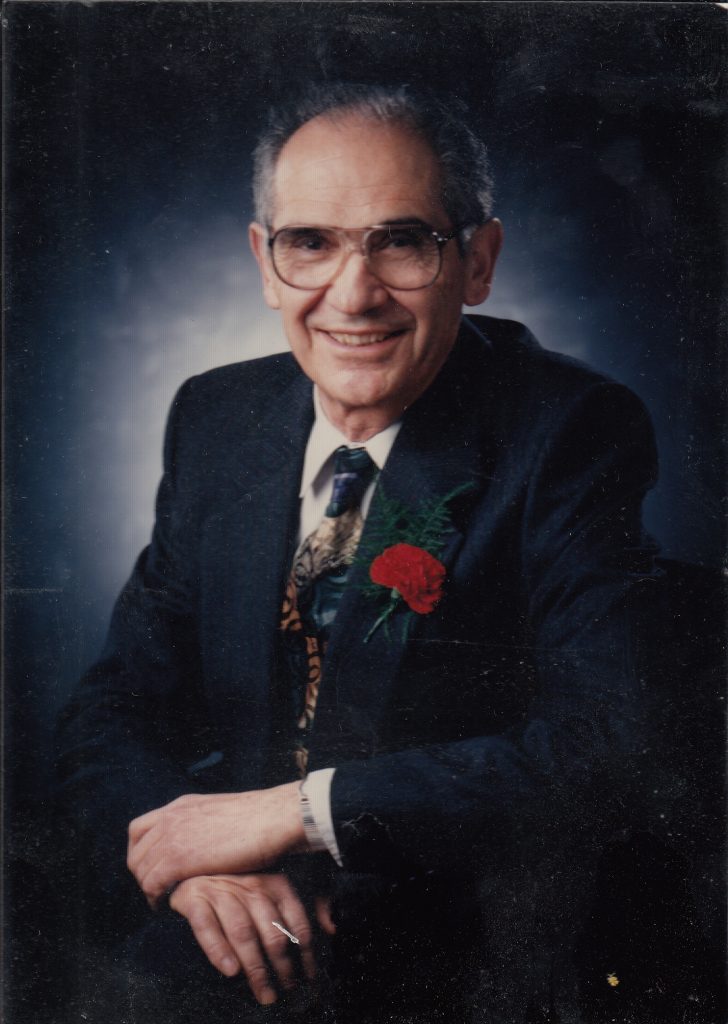
Preamble:
I thought I’d start with Dad’s advice on public speaking
Many years ago, back in the days where more hair grew on my head than I knew what to do with it, I had to do some public speaking. It was probably a high school presentation, but my memory is vague on that detail. What I do recall vividly is the advice my father gave me.
By this time, he was a foreman at Canada Packers and the job required that he hold a monthly safety meeting for the workers in his department. This was probably a group of forty to sixty people, so certainly bigger than any group I would be addressing. To top it off, English was not my father’s first language, so I could imagine he had reasons to feel anxious.
His cure? It was rather simple. He’d look at each person in the room, pause and think to himself, “You’re no better than me.”
He said that in a way that showed he fully believed it, and if you didn’t believe it, well then, maybe we had a problem. And by “we” I mean you had a problem with dad, because he was the one who stood six foot one and cut an imposing figure.
Since I didn’t inherit that imposing physique, I later developed my own technique for public speaking, which was to try or do something amusing as early as possible. Once someone laughs, the stress is gone.
However, I don’t think I’ll be doing that under these circumstances.
But I digress, which is something dad never did.
Eulogy
I think the story that best defines my father happened in 1986. He always liked to go out for walks, particularly in the ravine near our home. The path down to the ravine was treacherously steep. I don’t remember where I was that night, but when I got home dad wasn’t there–he was in a hospital.
When dad went down the hill, he slipped and fell, his left hand slamming into his leg so hard that he snapped the muscle connecting the thigh bone to the knee. Who knows how he was able to make it back up the hill and walk to a nearby home to ask for help?
He had an operation during the night to re-attach the muscle. The next morning, Dad looked as morose as I’d ever seen him. His left leg was inside an odd piston-like contraption. Its sole task was to bend his leg repeatedly so the muscle wouldn’t seize up.
Someone whose name I’ll never reveal took me aside and whispered, “Your father will never be the same again.”
I said nothing, but thought, “Really? This is dad we’re talking about here.”
The doctors told us the operation was a success. Dad would be able to go back to work in three months, with the aid of crutches. When the doctors left, dad had only one thing to say.
“I’m not going to work on crutches.”
I still remember picking him up from his first rehab session. He was beaming, and laughed triumphantly once the hospital and his physiotherapist were small objects in the rearview mirror.
As he put it, he had scared the physiotherapist by going full speed on the exercises, despite her pleas for him to slow down.
Slow down? Fat chance. Dad pushed himself at every bi-weekly session, and once home exercises were prescribed, he pushed away at those, too. After a month or so, he hunted around the house for wood scraps so he could put together a cane. When it was time to return to work, the crutches stayed at home.
This story defined dad. Provide a challenge and he’d rise up to meet it—like quitting smoking.
I guess dad started smoking cigarettes back in Italy. I don’t know when he switched over, but I only knew him as a pipe smoker. His pipe habit meant we always knew what to buy him for Father’s Day: a pouch of Amphora tobacco.
We had a subscription to Reader’s Digest, and every month there would be a feature article on the perils of smoking. So on this particular day, I asked dad why he still smoked.
“I can quit anytime I want to,” he replied.
I don’t recall who replied. Given its wise guy nature, it was probably me.
“Why don’t you quit now?”
Was that a challenge? Dad shrugged his shoulders.
“Sure.”
My mother swooped in and took the pipe and tobacco away. She said she would hide them to be sure he couldn’t smoke again.
Dad shrugged again. “Put them wherever you want. I said I quit.”
And so it was. Of course, from then on, we had to be more creative when it came to Father’s Day gifts.
Where did dad get that willpower? Probably from hard work.
When my uncle Gianni was born, his eleven-year-old brother Efrem was working in a neighbour’s field. Since that was during the Second World War, odds were good that the eleven-year-old was pushing a team of oxen instead of driving a tractor.
It was a tough life. The family home didn’t have running water or electricity. And there was never much money.
By the early 1950’s, dad was ready to leave. Canada was looking for workers. At the same time, Italy was embroiled in a border dispute with Yugoslavia and dad had already been called up twice to serve in the army. He wasn’t eager for a third tour of duty and signed up to go to Canada. He was sailing the Atlantic far sooner than he or his fiancée expected.
Yes, I said fiancée. Vannina DaRios went to a festival with three of her friends in the summer of 1952. Part of the festivities included getting a watermelon to share with your friends. Vannina and her friends were dismayed to crack open their fruit and see that it was all white rind.
Efrem and a male buddy witnessed this scene and came to the rescue with their perfectly ripe watermelon. One thing led to another, and before you know it, an unripe watermelon was the launching pad for a marriage which lasted just five weeks short of sixty-three years.
Dad landed in the Maritimes, but soon headed to Toronto, where he had a few jobs. He saved up enough money to bring Vannina over and they were married in May 1957.
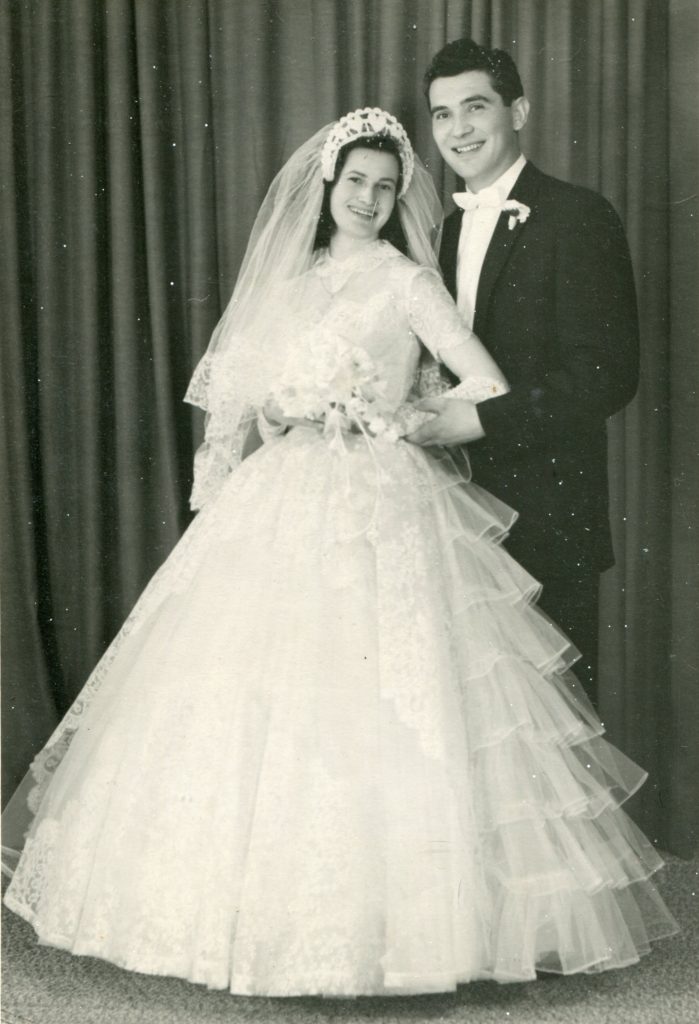
They rented an upper floor apartment on Emerson Avenue. At the time, he was working at Rowntree (the chocolate maker), and he told me how he would stick around the house until the last minute, when he’d run down to Sterling Road and punch in.
Working in a chocolate factory was a sweet gig, but there was more money in meat. Dad upgraded his paycheck when he started at Canada Packers in the late 1950’s. The Packers was a mainstay of Canadian industry at the time.
When we were children, dad worked steady afternoons at Canada Packers. During the school year, we only saw him on weekends. I still remember saying goodbye to him as he left for work one New Year’s Eve, and telling him I’d see him next year.
True to form, dad kept working. He took correspondence courses in high school English. He thought it was important to have a better command of English and I wonder if that’s what helped him become Head Foreman in the Cook Room and work permanent day shifts.
Dad worked hard, and he played hard. Every pastime he had, he took up with a passion. After he became Head Foreman, he took up bike riding as a way to reduce stress from work. He’d come home and hop on the bicycle. He found a group of fellow cyclists and they’d ride weekend mornings. After a month, dad told me there was always one fellow always leading the group and one day he’d catch up. It didn’t take very long before he did.
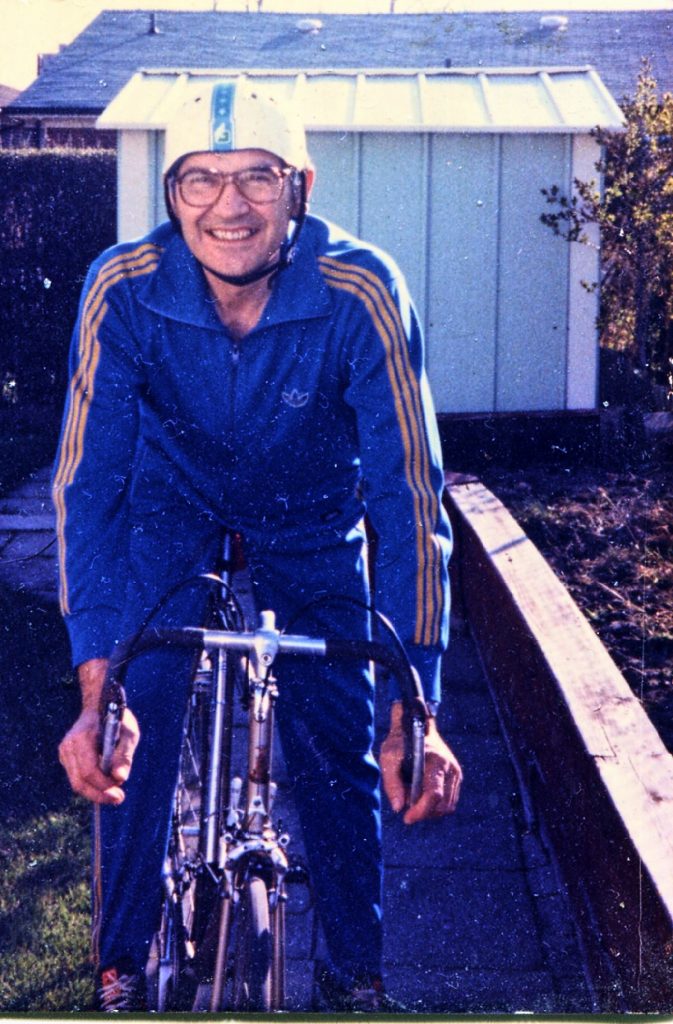
Since he couldn’t ride in winter, he took up cross country skiing. If it was too rainy to ride the bike, or there wasn’t enough snow to ski, dad would go for a walk—something he could do year round. The weather had to be really bad to keep him inside.
Otherwise, he was on the move.
He loved to eat. He loved to read, especially detective novels. He kept a stack of novels by his favorite chair, replenished by regular trips to the library.
He was a self-made handyman. Car trouble? Get a book from the library, grab the toolbox, open the hood and fiddle around. Bike problems? There were books for that, too. In fact, I bought him a pretty good one. He got so good at bike repair and general maintenance that many people brought their bikes over for him to work on.
Given his farming and cultural background, it shouldn’t be surprising that he made his own wine. Like so many of his fellow countrymen, dad used to buy boxes and grapes every fall and pulp them. Then he took it a step further. He asked questions, read some books, and the next thing I knew, he was buying select juices, mixing them to create better tasting wines then what he used to make. He got good enough at it that he was asked to provide wine for social functions. He even got paid a few times.
Dad was quite the woodworker. The house still has his bookcases, shoe racks, and footstools. Probably his biggest project was renovating a family room. And an hour after he finally finished, his oldest son was in a pretty good mood and forgot the ceiling was lower. I jumped up and put my head through the ceiling. I remember the look on his face when I worked up the courage to tell him what happened. Probably because his reaction was so low-key. “Well of course my kid put his head through the ceiling.” He replaced the tile and that was it.
He built a number of nice things. Not so nice were the ramps he built so he could go under the car. He hammered together a motley collection of wood scraps and loose lumber. Every time he used them, I’d hover around, thinking, “If the car falls on him, will I be like those mothers I read about? Will I get an adrenaline rush to lift the car off him?”
I made sure that his birthday present that year was a set of metal ramps.
When there was a job to be done, he’d dive right in. That didn’t always go smoothly. Sometime in 1992, dad decided that our shared front lawn needed a hedge down the middle. That morning, I told him to wait for me before digging. There were calls to be made and I’d do that right after I ate. Dad nodded.
When I finished breakfast, I found dad had already planted a row of tiny shrubs halfway up the lawn. I shrugged my shoulders. Dad was a fast worker, and I was a slow eater.
Eric Clapton would be on MuchMusic performing “Unplugged” that night, and I wanted to record it. Being a tad obsessive, I checked the TV. Snow.
I ran to the front lawn. Right next to one of the shrubs, a broken cable peered up at the sky. I calmly explained to dad what he had done.
“You know something?” he said. “When I dug up the backyard for the vegetable garden, I cut the telephone cables.”
I did not watch “Eric Clapton Unplugged” that night. It’s just as well. I never cared for the acoustic version of “Layla.”
We got the TV cable repaired. And years later, the shrubs provide a lush green wall.
Dad’s hands were something else. He was a tall man with wide shoulders, but I always thought that the source of his strength and work ethic lay in those hands.
One morning I prepared to shave. My razor was broken, with large cracks down both sides of the head. Dad was up earlier. His razor wasn’t charged, so he used mine. Being a considerate type, he removed the head after he was done and shook out the hairs. Then he put the cap back on. But it was facing the wrong side.
His grip was so strong, he pushed the cap back in place, even as the plastic sides broke apart. And he didn’t notice.
After that incident, I tried to be in the general vicinity whenever assembly was required with plastic parts. If I heard dad grumble about Part A not going into Slot B, I’d offer to help.
Also, I made sure my next electric razor stayed in my bedroom.
He was selfless when it came to family. While I was still in high school, he got me a part time job working Night Sanitation Saturday nights at Canada Packers. I didn’t have a driver’s license when I started. There was a bus I could take Saturday night, but back then, there weren’t any buses running at 5:30 Sunday morning.
No worries. Dad got up 5:15 a.m. every Sunday and made the fifteen minute drive to pick me up.
Dad would spend the early years of his retirement driving out to Brampton every weekday. He and mom had a weekly schedule to take care of their grandchildren: three days where they split up between homes in Bramalea and Brampton, and the other two, they spent together in Brampton.
Whenever any family member had something to be built, moved, or pulled apart, they could count on dad to show up if asked.
That would change the last few years. Dementia made its mark quickly. I remember noticing his memory issues and took him to the family doctor where he took a test.
I drove home as he wondered about the questions he got wrong. He didn’t know Justin Trudeau was the Prime Minister.
“How did I forget that?” said the man who read the Toronto Star every single day since the early 1960’s.
He had passed his driver’s test for his 84th birthday. A few months after he turned 85, a gerontologist would take the license away.
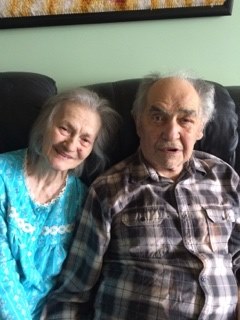
Even in the final years, there were bright spots.
One of them was the emergence of “Singing Dad.” He would break out into song out of nowhere. Most of the time it was something from Latin Mass or Italian folk songs, especially “Volare”. Sometimes he would sing back random phrases that mom or I said. What I found fascinating was how he was always in pitch.
His rich baritone was loud, very loud, but never unpleasant. Non-family visitors would ask where dad had sung in the past.
Where? Nowhere. No family member could recall hearing him sing. Was this a talent he had suppressed his entire life? Was this the dementia crossing wires in his brain and creating a minor-league Pavarotti? I meant to record him but the singing stopped just as suddenly as it had started.
While I can never know how he felt about his mind failing, it was obvious that dad still found pleasure in some things. His love of food lasted almost until the end. Everyone who encountered him during his final years, be they family, support staff, or the poor souls stuck in the hospital rooms with him, quickly knew the word, “mangiare.”
It’s Italian for “to eat.” For dad, it meant, “feed me”. And he was always ready to eat. In a hospital bed in the middle of the night? MANGIARE. Nurse over for a check-up? MANGIARE. Getting Angelo out of bed at 4 in the morning? MANGIARE.
It became a catch phrase that amused us. When it wasn’t driving me crazy; that is. With me, dad got creative. Mangiare addesso (eat now). Mangiare tutto (eat everything). Mangiare subito (eat right away).
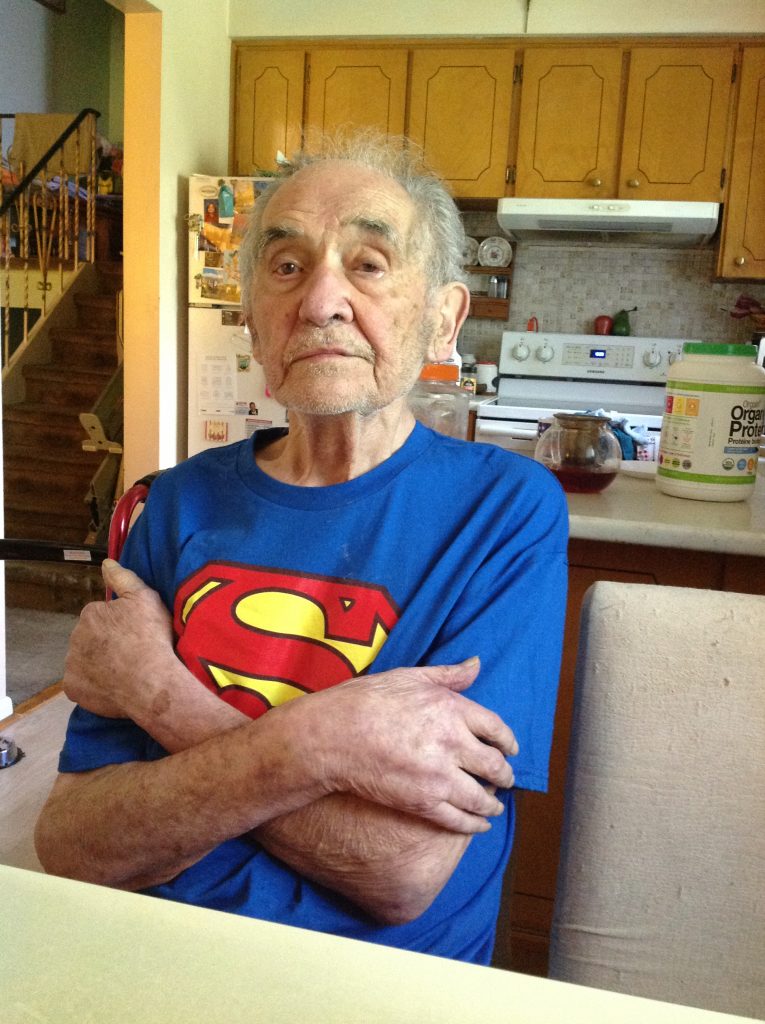
Even in dementia’s foggy grip, dad could be playful.
In September 2019, dad spent a week in hospital for heart issues. When he was sent home, the doctor told me to watch for any breathing problems.
That very night, his breathing sounded like a bad cold. It stayed that way into the morning and he had to return to the hospital. After calling a doctor, I went back to the bedroom. Up until now, I could hear his labored breathing even outside the bedroom. But now I couldn’t hear anything. He was quiet. Scary quiet.
I drew closer. I called his name but got no response. He was so still. I had to come right up to his face to check his breathing.
Dad raised his face to mine and barked—then laughed when I jumped back.
The end came quickly and quietly, surrounded by family.
In the days after his passing, I looked at so many photographs featuring dad. I was struck by how he seemed to be smiling in all of them, happy in the moment. My father was not the kind of person who would sit and over-think things. I believe he took joy in all the small pleasures of life, whether it was eating, exercising, or working with his hands. He came to Canada with very little and was able to buy a house, raise a family, and earn enough money to be totally secure in his old age.
All in all, I think he got what he wanted from life. He loved his wife. He loved his family.
A good life. And he left a lot of memories.
Goodbye, dad.
Efrem Furlan Obituary from the Toronto Star: